Blank Maps, Open Windows
How Loper Bright, the Endangerment Rescission, and a Quiet Judicial Deletion Reshapes Climate Law

I. Loper Bright and the End of Chevron Deference
On the evening of Friday, February 6, 2026, Judge Robin Rosenberg, Director of the Federal Judicial Center, sent a letter to West Virginia Attorney General John McCuskey. It contained one operative sentence: “the Federal Judicial Center has omitted the climate science chapter from the Reference Manual on Scientific Evidence, Fourth Edition.”[1]
No explanation was offered. The Center declined to comment. The letter was released at close of business on a Friday — which is how institutions bury things they would rather not discuss.
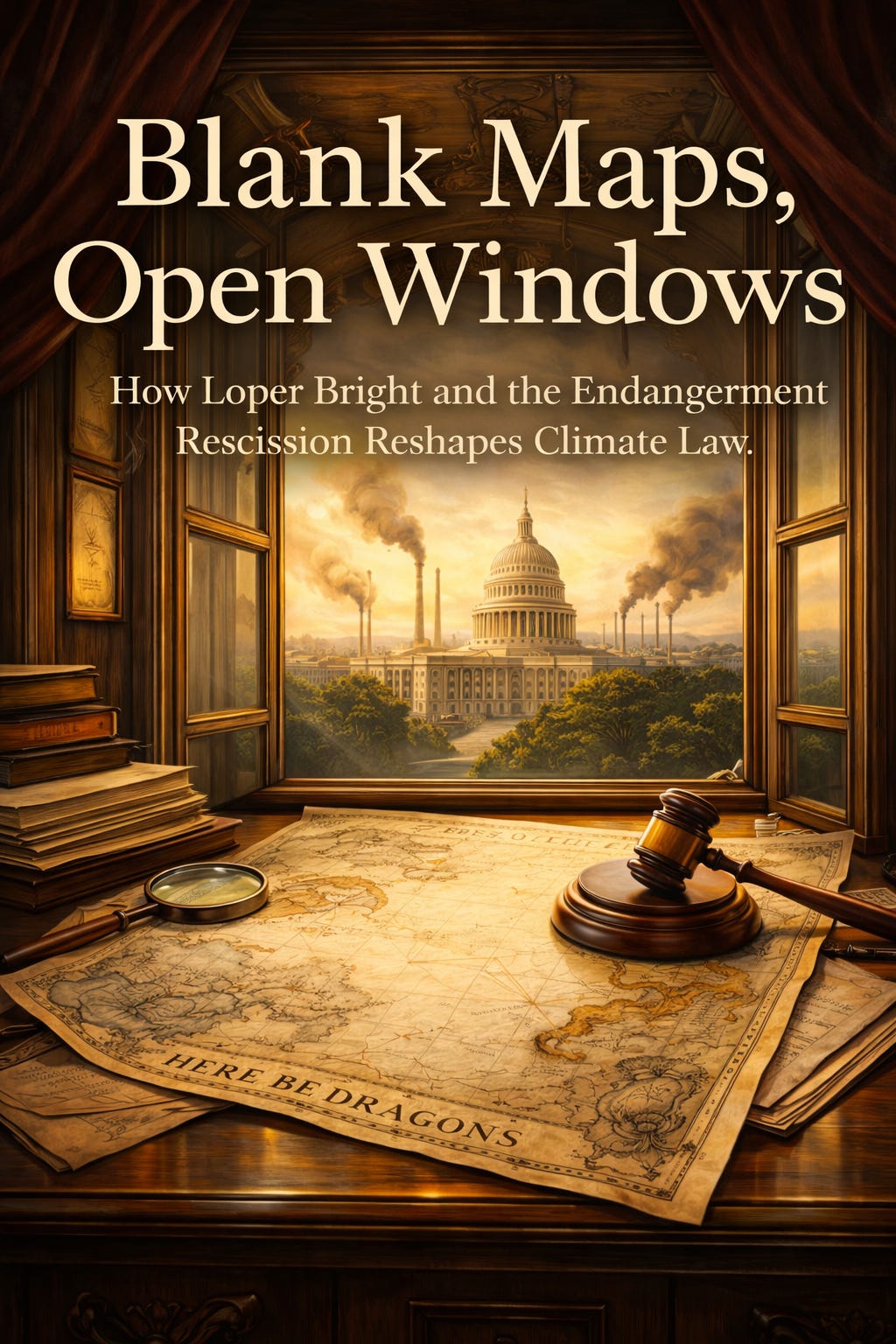
Six days later, on Thursday, February 12, President Trump stood at the White House alongside EPA Administrator Lee Zeldin and announced the formal rescission of the agency’s 2009 Endangerment Finding — the regulatory cornerstone that had authorized the federal government to regulate greenhouse gases as pollutants dangerous to public health and welfare.[2] That announcement was loud. It was described, accurately, as the largest deregulatory action in American history. It generated headlines across every major outlet, statements from former presidents, and immediate litigation threats from state attorneys general. A single administrative sentence that had been quietly released the previous Friday — removing a single chapter from a judicial reference manual — had by then been largely absorbed into the ambient noise of the intervening week.
The six days between the two acts are not incidental. They are structural. The deletion was buried on a Friday evening; the announcement consumed the following Thursday’s news cycle. Together, the sequence accomplished what neither act could have accomplished alone: the removal of the executive branch’s statutory authority to regulate greenhouse gas emissions, and the removal of the judiciary’s official framework for evaluating the science that underlies any legal challenge to that removal. The regulatory pillar and the judicial map, gone within a single week, in a sequence whose components were reported as unrelated events and processed, where they were processed at all, as background noise. To understand why the sequence matters requires stepping back eighteen months.
In June 2024, in Loper Bright Enterprises v. Raimondo, a 6–3 Supreme Court majority declared Chevron deference overruled.[3] The doctrine it overturned had been established in a 1984 case arising from an EPA dispute: where Congress had left statutory language ambiguous, and a federal agency had developed expertise in the relevant domain, courts should defer to the agency’s reasonable interpretation rather than substitute their own. For forty years this arrangement functioned as the connective tissue between legislative intent and regulatory reality. Agencies like the EPA employed scientists, economists, and engineers. Judges, however brilliant, did not. The doctrine recognized that distinction and drew its authority from it.
The Court held in Loper Bright that judges must now exercise independent judgment in determining the meaning of statutory provisions — including those requiring deep scientific and technical understanding. The reasoning was constitutionally tidy: it is the province of courts to say what the law is, not the province of executive agencies. The practical consequence was considerably less tidy. Forty years of regulatory architecture had been built on the assumption that agencies would fill the technical gaps that legislatures inevitably leave. That assumption was now void.
Justice Elena Kagan, dissenting, saw the mechanism precisely. The majority, she wrote, had given itself “exclusive power over every open issue — no matter how expertise-driven or policy-laden — involving the meaning of regulatory law.”[4]She was not being rhetorical. The Court had just handed federal judges a set of keys to rooms they had never been required to enter, in a building whose blueprints they had never been required to read.
What it had not handed them was a map.
The constitutional theory was elegant. The constitutional reality has proved considerably less so — and in ways that illuminate how institutional power, dislodged from one vessel, does not distribute itself tidily among the remaining ones. Congress has not risen to fill the interpretive space that Loper Bright cleared. Legislating with the technical precision that complex regulatory domains require — specifying in statutory language exactly what greenhouse gas concentrations are permissible, exactly what constitutes an endangered species habitat, exactly what safety margins govern a pharmaceutical approval — is not something the contemporary Congress has demonstrated either the appetite or the capacity to do. The gaps that Chevron allowed agencies to fill were not gaps born of legislative laziness. They were gaps born of the irreducible complexity of governing a technologically sophisticated society through a political process designed in the eighteenth century for a largely agrarian one.
Into that space — the space between what Congress has specified and what governance requires — something has moved. It is not the legislature. It is not, as we shall see, an empowered judiciary. It is the executive branch itself, operating now not through the rulemaking process that Chevron once governed and courts once reviewed, but through executive orders, agency guidance documents, permit approvals, and enforcement discretion — instruments that are structurally harder to challenge, procedurally faster to deploy, and politically more concentrated in the person of the President than the regulatory architecture they replace. The rescission of the Endangerment Finding is the most consequential single expression of that shift. It is also the one most easily misread as an isolated event.
The Endangerment Finding was not a minor regulatory decision. It was, in the EPA’s own framing at the time of its 2009 issuance, the legal foundation for virtually all subsequent federal climate regulation — the statutory determination that greenhouse gases, by threatening public health and welfare, qualified as pollutants subject to regulation under the Clean Air Act.[5] Every major EPA climate rule of the subsequent fifteen years rested on it. Its rescission does not merely change one rule. It removes the scientific and legal predicate that justified an entire architecture of federal environmental regulation. The courts that would ordinarily review such a removal are the same courts that Loper Bright has simultaneously rendered less capable of evaluating the scientific record on which any challenge must rest.
This is the constitutional irony that the Loper Bright majority either did not anticipate or chose not to acknowledge. By crippling the administrative state’s interpretive authority and simultaneously overwhelming the judiciary with technical responsibilities it is poorly equipped to discharge, the decision has not restored the balance among the three branches. It has created a vacuum. And vacuums, in politics as in physics, are filled by whatever force is most immediately available and least encumbered by procedural friction. In the current moment, that force has a name and an address.
The citizen who watches the courts produce inconsistent rulings across different circuits does not typically conclude that the legislative branch should exercise greater statutory precision. What is experienced is paralysis, contradiction, and the sense that the formal mechanisms of democratic governance have become detached from the practical problems they were designed to address. The natural response to that experience is not renewed faith in congressional deliberation. It is the search for someone who will simply decide — who will cut through the procedural undergrowth and deliver an outcome. The demand, in other words, for the strong executive that Loper Bright was theoretically designed to constrain.
This is not a new dynamic in republican governance. It is one of the oldest. Republics do not typically collapse because their institutions are abolished. They hollow — the formal structures persist while the practical authority migrates toward whoever can act with speed and certainty in the space that institutional paralysis vacates. The history of republican legal systems under pressure contains no shortage of examples: a legal inheritance grown too complex, too contradictory, and too slow to serve the needs of a society under stress, resolved by systematization in service of concentrated authority.[6]The parallel, in the context of the present sequence, is not decorative. It is diagnostic.
The Federal Judicial Center exists, in part, to provide exactly the kind of navigational resource that Loper Bright made newly essential. Created by Congress in 1967 as the research and education agency of the federal judiciary, it is chaired by the Chief Justice of the United States and charged with helping judges understand the complex scientific, technical, and empirical questions that increasingly arrive before them.[7] Its Reference Manual on Scientific Evidence — updated periodically over three decades — is not a policy document. It takes no position on outcomes. It is cartography: here is what this field of science is, here is how its evidence is generated and evaluated, here is what constitutes expertise within it, here is what questions remain genuinely contested and what questions do not.
The fourth edition, released on December 31, 2025, was the first update in fourteen years.[8] It included, for the first time in that interval, a substantial chapter on climate science — ninety pages designed to help judges evaluate climate evidence in an era when, following Loper Bright, they would be required to evaluate it themselves rather than defer to those who had spent careers doing so. The timing was not incidental. The manual’s authors understood what the Supreme Court had done. They were attempting to equip the bench for the new territory it had been assigned.
The chapter lasted thirty-seven days.
On January 29, 2026, a coalition of twenty-seven Republican state attorneys general, led by West Virginia, wrote to the Federal Judicial Center demanding the chapter’s immediate withdrawal.[9] Their argument was procedural in form and strategic in substance: the chapter, they contended, placed the judiciary “firmly on one side of some of the most hotly disputed questions in current litigation,” undermining judicial impartiality. The science of climate attribution — how researchers establish causal links between emissions, warming, and specific weather events — was, they argued, not settled guidance but contested advocacy, and embedding it in a judicial reference manual was tantamount to pre-deciding cases before they were heard.
Eight days later, Judge Rosenberg wrote her one-sentence letter.
What the attorneys general did not note, and what the letter did not address, is that the cases driving their concern do not primarily dispute the underlying science of climate change. They dispute corporate liability for its consequences. The science is the foundation, not the argument. Removing the chapter did not resolve a contested scientific question. It removed the official framework within which judges were meant to evaluate one. The distinction is not semantic. A blank page where a map should be is not neutrality. It is a different kind of instruction entirely.
Nor is the judicial manual deletion separable from the Endangerment Finding rescission that followed six days later. The rescission removes the EPA’s statutory authority to act on climate science. The deletion removes the judiciary’s official tools to evaluate it. One act addresses what the executive branch may do; the other affects what the judicial branch can reliably assess. The combined effect is not additive. It is architectural: two pillars of the regulatory and legal framework for addressing climate change, removed in sequence, each making the absence of the other more consequential.
II. The Map That Wasn’t: The New Federal Judicial Manual
Medieval cartographers did not leave spaces blank because they lacked imagination. They left them blank because they lacked authority. The edges of the known world were not empty — they were full of geography, of coastlines and rivers and mountain ranges that simply had not been certified by any source the mapmaker could responsibly cite. Terra incognita was a precise epistemological category, not a poetic one. It did not mean that nothing was there. It meant that what was there had not been officially established. The territory was a known unknown: its existence was acknowledged, its general dimensions were understood, but its specific features could not be authoritatively represented. The cartographer knew he did not know. He said so. Beyond this point, the map cannot help you.
The Federal Judicial Center’s one-sentence letter of February 6, 2026 placed climate science in exactly that category — a known unknown — for a federal judiciary that had just been told it was now responsible for navigating it. The science itself is not unknown. Its existence, its broad dimensions, its peer-reviewed literature are matters of extensive and accessible record. What is now officially unknown — what has been made unknown, through the withdrawal of the chapter and the rescission of the Endangerment Finding — is its status in the authoritative frameworks that courts rely on to do their work. The territory exists. The official record will no longer say what it contains.
To appreciate what was removed, it is necessary to understand what the Reference Manual on Scientific Evidence actually is — and is not. It is not a textbook. It is not a policy brief. It is not, as its critics characterized it, a vehicle for advocacy dressed in the clothing of education. It is, in the most technically precise sense, a framework for evaluating evidence — a guide to what questions a judge should ask of an expert witness, what methodological standards distinguish reliable science from unreliable science in a given domain, and what the current state of knowledge in that domain actually is. Earlier editions have been cited by federal courts more than a thousand times.[10] They are cited not because judges are required to follow them, but because they provide exactly what a non-specialist decision-maker most needs: not conclusions, but the tools to evaluate competing claims about conclusions.
The climate science chapter that existed for thirty-seven days was precisely that. It did not tell judges how to rule. It told them how climate science works — how temperature records are constructed and validated, how atmospheric models are built and tested, how attribution science establishes causal relationships between emissions and specific weather events, and crucially, what within that body of science represents genuine expert consensus and what remains at the frontier of legitimate inquiry.[11] It was a map of the known world — not of the destinations judges might be asked to reach, but of the terrain through which they would have to travel to get there.
That map is now blank.
What fills the blank matters enormously, and what fills it in the absence of official guidance is not nothing. It is the adversarial process itself — which is to say, it is whatever the better-resourced party can afford to put before the court. This is not a trivial observation. The adversarial system functions well when both parties have roughly comparable access to expertise, when the factual terrain is well-charted enough that expert claims can be efficiently tested, and when the judge has sufficient background understanding to distinguish genuine scientific dispute from manufactured controversy. Remove those conditions and the adversarial process does not produce truth. It produces the appearance of contest — a performance of equivalence between positions that are not, in the scientific community, equivalent — and it produces that appearance most reliably when one side has the resources to sustain it and the other does not.
The tobacco industry understood this mechanism with great sophistication. For decades its legal strategy rested not on proving that cigarettes were safe but on sustaining the appearance that the question was genuinely open — that the science was contested, the experts divided, the evidence ambiguous.[12] The strategy did not require winning the scientific argument. It required preventing the scientific argument from being conclusively lost in the one forum where it mattered most: the courtroom. A judge without a reliable framework for distinguishing genuine scientific uncertainty from manufactured scientific uncertainty is not a neutral arbiter.
The rescission of the Endangerment Finding operates on the same logic, but at the statutory rather than the evidentiary level. The Finding had been upheld by federal courts on multiple occasions, most recently when the D.C. Circuit affirmed it in 2012.[13] Those rulings rested on the court’s determination that the EPA’s scientific conclusions were rational and evidence-based — a determination made possible, in part, by a judicial reference framework that oriented courts toward the peer-reviewed consensus on climate science. Strip both the Finding and the reference framework simultaneously, and the legal landscape that a challenger to the rescission must navigate has been fundamentally altered: the EPA no longer has the regulatory authority, and the courts no longer have the official interpretive tools, that previously allowed climate science to anchor federal environmental law.
The removal of the climate science chapter from the judicial reference manual does not create manufactured uncertainty. That work has been done elsewhere, as we shall see. What it does is remove the official counterweight — the judiciary’s own certified framework for identifying where the genuine scientific frontier lies and where the appearance of frontier has been constructed for strategic purposes. The blank map does not favor ignorance equally. It favors the party with the resources and incentive to fill the blank with its own cartography.
The practical consequences for climate litigation are structural, and they compound at every level of the judicial hierarchy. At the district court level, a judge confronting a climate attribution case — a municipality suing fossil fuel companies for damages from flooding, or coastal erosion, or infrastructure destroyed by extreme heat — must now independently evaluate competing expert testimony about whether a specific weather event was made more likely or more severe by anthropogenic emissions. Attribution science is a sophisticated and rapidly developing field.[14] Its methodologies are legitimate, its peer-reviewed literature extensive, and its conclusions, in the mainstream scientific community, well-established. It is also a field whose findings are directly material to billions of dollars in potential corporate liability — which means it is a field in which the incentive and the resources to generate contrary expert opinion are enormous.
Without the reference manual’s climate chapter, the district court judge has no official framework for evaluating whether the expert witness presented by the defense represents a genuine scientific counterpoint or a well-funded outlier whose views find no support in the peer-reviewed literature. He must make that determination from first principles, in real time, under the pressure of an adversarial proceeding — in a climate where the executive branch has simultaneously declared, through the Endangerment Finding rescission, that the federal government no longer officially regards greenhouse gases as a threat to public health. That declaration is not legally binding on the courts. But it is a signal. And signals, in adversarial proceedings, have weight.
Judges will make a determination. Judges always do. But the determination will rest on a foundation that is, by design, less stable than it should be. And because the foundation varies — because different district courts bring different backgrounds, different instincts, and different access to informal expertise — the determinations will vary too. Not randomly, and not merely because the facts of individual cases differ, but systematically, in ways that reflect the epistemic resources available in different jurisdictions and the different pressures applied to courts in different political contexts.
That variation is the mechanism by which a circuit split is born.
There is a further dimension that receives less attention than the litigation dynamics but may prove more consequential in aggregate. It concerns not the cases that are filed but the cases that are not. Climate litigation is expensive. Expert witnesses cost money. Appeals cost money. The municipalities, states, and community organizations that bring climate cases are not, as a class, well-resourced relative to the defendants they sue. They bring these cases when the cost-benefit calculation is favorable — when the legal terrain is sufficiently charted that the investment of litigation resources is not simply consumed by foundational uncertainty about whether the theory will survive. Remove the official cartography and that calculation changes. Cases that would have been filed are not filed. Claims that would have been pursued are settled below their value or abandoned. The blank map does not need to produce adverse rulings to do its work. It needs only to make the journey expensive enough that some travellers decide not to begin.
The judicial branch did not ask for this condition. Having been handed responsibility for evaluating climate science by the Supreme Court, the Federal Judicial Center produced the resource necessary to discharge it. That resource was then withdrawn, within a week, in response to a letter from twenty-seven state attorneys general whose clients have a direct financial interest in the terrain remaining unmapped — at the precise moment when the executive branch was simultaneously removing the scientific determination that had given that terrain its regulatory significance.
The judiciary now stands at the edge of the known world, holding a blank page where the chart should be, responsible for navigation it was not designed to perform, in territory whose features have been officially uncertified — not because they are unknown, but because certifying them has become politically costly.
III. Here Be Dragons
Medieval cartographers did not write here be dragons as decoration. But it meant something different from terra incognita. Where terra incognita acknowledged a known unknown — the territory is there, we cannot certify its features — here be dragons marked the unknown unknown. Not merely that the map ran out, but that what lay beyond it could not be anticipated at all. The cartographer was not saying: beyond this point, the record is incomplete. He was saying: beyond this point, the categories themselves may not hold. Whatever is out there, we have no framework for describing it. We only know that those who enter do not come back with reliable reports.
The federal judiciary now stands at precisely that boundary. To its west lies the charted territory of forty years of Chevron deference — a landscape whose features were known, whose pathways were established, whose hazards were documented. To its east lies the post-Loper Bright terrain: novel, unmapped, and stripped of the official frameworks that would allow its features to be described. We can name three conditions the terrain creates — three structural dynamics already in motion. We can describe the mechanisms by which they operate. What we cannot do, because no one can, is specify where those mechanisms lead. The dragons of the unknown unknown are not undefined because we have failed to study them. They are undefined because their outcomes are genuinely contingent — on political conditions, on judicial appointments, on the pace of infrastructure development, on the erosion of civic expectations that cannot be measured until it has already occurred. We know the conditions. We do not know what the conditions will produce. That is what makes them dragons rather than merely difficult terrain.
The First Dragon: The Fracture
It does not announce itself dramatically. It emerges the way most institutional failures emerge — gradually, through the accumulation of individually defensible decisions that are, taken together, irreconcilable. A district court judge in the Ninth Circuit evaluates climate attribution science as best she can without official judicial guidance, weighs the peer-reviewed literature against competing expert testimony, applies the Daubert standard for scientific admissibility,[15] and concludes that the plaintiff’s scientific claims are sufficiently grounded to proceed. A district court judge in the Fifth Circuit performs the same evaluation with the same absence of official guidance, brings different professional instincts to bear, and concludes that the same body of science does not meet the admissibility threshold. Neither judge has done anything wrong. Both have exercised exactly the independent judgment that Loper Bright required of them. The outcomes are irreconcilable.
The rescission of the Endangerment Finding deepens this fracture. Courts in circuits historically sympathetic to environmental regulation will struggle to assess challenges to the rescission without the reference framework the manual provided. Courts in circuits historically more deferential to executive deregulatory action will use the rescission itself as evidence that the scientific basis for climate regulation was always disputed — despite the fact that the scientific consensus documented in the now-removed chapter says otherwise.[16] The blank map does not create this asymmetry. It amplifies one that was already structurally present.
The litigation map becomes a strategic document — not a guide to where justice is available, but a guide to where the jurisdictional currents run most favorably. Plaintiffs with strong cases seek the Ninth Circuit’s jurisdiction. Defendants with strong removal arguments seek the Fifth’s. The system that was designed to test legal questions across multiple jurisdictions and refine them through competing interpretations begins instead to sort parties by their capacity to navigate jurisdictional complexity — which is to say, by their resources. Dead reckoning, as every maritime historian knows, is how ships find their way for a time. It is also how they eventually run aground.
The circuit split is not merely a legal inconvenience awaiting Supreme Court resolution. It is, during the interval between its emergence and that resolution — an interval that in complex litigation routinely measures in years and sometimes decades — a condition of structured inequality. The same scientific evidence is reliable in one circuit and inadmissible in the next. The same community, facing the same harms from the same sources, has access to fundamentally different legal protection depending on which side of a circuit boundary it happens to inhabit.
This is the first dragon. It is the most visible. What makes it dangerous is not its existence but its duration. And what its duration permits is the second.
The Second Dragon: The Window
Between the emergence of the circuit split and its eventual resolution lies an interval. In ordinary litigation, this interval is an inconvenience — a period of legal uncertainty that creates planning difficulties for regulated industries and strategic complications for litigants. Climate litigation is not ordinary litigation. The physical landscape over which it is fought is precisely what is at stake — and that landscape can be, and is being, permanently altered during the interval that the first dragon creates and the second dragon inhabits.
The mechanism is straightforward enough to be described without euphemism. A fossil fuel company seeking to develop a new extraction project, or expand an existing one, or commission a new pipeline through a community that would otherwise have grounds to challenge it, faces two possible futures. In the first, the legal framework governing its liability for climate-related harms is clear, consistent, and enforced — the scientific basis for attribution claims is officially established, the courts are equipped to evaluate it, and the cost of proceeding with environmentally harmful development includes a reliable estimate of the legal exposure that development will eventually generate. In that future, the company makes a rational calculation that includes the full cost of its actions.
In the second future — the one the circuit split and the blank judicial map together create, reinforced by a federal government that has simultaneously declared through the Endangerment Finding rescission that greenhouse gases no longer require regulatory restraint — that calculation is unavailable. The legal framework is contested. The scientific evidentiary basis is officially uncertain. Courts in some jurisdictions will entertain liability claims and courts in others will not. In this future, the rational calculation for a company with the resources to sustain litigation and the political connections to accelerate permitting is straightforward: build now. Move fast. Create facts on the ground before the law catches up.
This is not conjecture. It is the explicit logic of the administration’s own permitting acceleration agenda. The White House Council on Environmental Quality has argued publicly that America cannot afford to wait for environmental review processes to run their course — that while legal and regulatory processes grind forward, physical infrastructure must be built.[17] What this framing omits is that the grinding quality of those processes has been deliberately engineered, and that the urgency it creates benefits a specific and identifiable set of interests.
The exploitation window operates through a mechanism that lawyers call the fait accompli — the accomplished fact. A project that is built, operational, and employing people before a court rules on its legality is a fundamentally different defendant than a project that exists only on paper. Courts weighing injunctions against operational infrastructure must consider not only the legal merits of the challenge but the practical consequences of granting relief. The fait accomplidoes not make the legal challenge disappear. It changes the cost-benefit analysis of the remedy. It transforms the legal question from whether the project should have been built into whether the project, having been built, can practically be unbuilt.
Each project completed during the window is a permanent alteration of the terrain that the Supreme Court will eventually be asked to map. By the time the Court draws the authoritative cartography, the territory will already have been settled — not by legal process, but by the physical momentum of development that legal uncertainty enabled and regulatory acceleration facilitated. The rescission of the Endangerment Finding accelerates this settlement. Without the Finding, the EPA has no statutory obligation to regulate greenhouse gas emissions under the Clean Air Act. Without that obligation, the legal pressure on new fossil fuel development is substantially reduced before any court has issued a word on the merits. The window widens.
There is a further dimension that receives less attention than the visible litigation dynamics but may prove more consequential in aggregate. It concerns not the cases that are filed but the cases that are not. Remove the official cartography and the cost-benefit calculation for potential plaintiffs changes fundamentally. Cases that would have been filed are not filed. Claims that would have been pursued are settled below their value or abandoned. The exploitation window does not need courts to rule against plaintiffs to do its work. It needs only to make the journey expensive enough that some travelers decide not to begin.
The projects built on those unbegun journeys are the second dragon’s most durable legacy. They are also the kindling for the third.
The Third Dragon: The Erosion
The third dragon is quieter than the first and more dangerous than the second, because it does not operate on infrastructure or legal doctrine. It operates on civic faith — on the accumulated public understanding of whether the institutions of democratic governance are responsive to the needs of the people they serve. And it is fed, systematically and consequentially, by everything the first and second dragons do.
The citizen who watches the judicial system produce contradictory outcomes on questions of plain consequence to her community — who watches a comparable municipality win in one state what her own cannot pursue in another, who watches infrastructure approved and built while the legal challenges that might have stopped it work their way through a system that seems constitutionally incapable of moving at the speed of the harm it is meant to address, and who watches the federal government simultaneously declare that the harm is not officially recognized — does not read this as a technical legal condition awaiting resolution. She reads it as evidence that the system does not work. Or more precisely, that it does not work for her.
Federal judges derive their authority from no popular mandate. They are appointed, not elected. They serve for life. They command no armies and control no budgets. The entirety of their practical authority rests on a single, continuously renewed civic compact: that their rulings represent the application of known standards to established facts in ways that are consistent, predictable, and legitimate. The circuit split corrodes that compact directly and visibly. The exploitation window makes the corrosion irreversible. A legal system cannot produce a public record in which climate attribution science is simultaneously reliable and unreliable, depending on geography, without generating the reasonable public inference that the reliability of science in federal court is a function of something other than the science.
A regulatory system that rescinded a scientific finding upheld by the D.C. Circuit[13] and confirmed by subsequent peer review[18] — and that did so on the same day that the judicial framework for evaluating that science was removed — cannot expect its actions to be read as motivated by genuine scientific uncertainty. They will be read, reasonably, as motivated by the interests the rescission serves. That inference, once made widely enough and durably enough, does not produce renewed faith in congressional deliberation or patient confidence in the Supreme Court’s eventual resolution. It produces the demand for an alternative.
For someone who will simply decide. For the strong executive who will cut through the procedural undergrowth that the formal institutions seem constitutionally unable to clear. For the leader who appears to be the only actor in the system capable of moving at the speed the problem requires.
This demand does not need to be manufactured. It arises organically from the experience of institutional failure. The courts have been burdened with responsibility they cannot discharge, stripped of the tools they would need to discharge it, and left to produce the inconsistent outcomes that will ratify the conclusion that the system has failed. The executive branch has simultaneously removed the regulatory predicate that gave courts their clearest basis for holding climate polluters accountable. The dragon of eroded legitimacy was not an unintended consequence of the moves described in this piece. It was, at minimum, a predictable one. The distinction between the predictable and the intended is, in the current context, a distinction without a practical difference.
Here be dragons. All three of them. We can name them. We can describe the conditions they create. What we cannot know — what remains genuinely unknown — is what those conditions will ultimately produce.
The first — the circuit split, the forum shopping, the manufactured inconsistency of a judiciary navigating without maps — is visible on the formal record. Its conditions can be tracked in appellate opinions and documented in academic literature. What cannot be predicted is which circuit splits harden into permanent legal geography, which cases settle in the shadow of irresolution, which communities on which side of which jurisdictional boundary absorb which costs from that geography. The mechanism is legible. The outcomes are not.
The second — the exploitation window, the fait accompli, the permanent reshaping of the physical landscape during the interval that the first dragon creates — leaves its record not in court documents but in the ground itself. In pipelines laid and wells drilled and power plants commissioned during the years when the law could not decide what it thought of them, in a regulatory environment whose retreat was formalized through the Endangerment Finding rescission. We know that development accelerates during legal uncertainty. We do not know which projects will be built, which communities will absorb their costs, which physical changes will prove irreversible by the time the legal framework catches up. The window is known. What passes through it is not.
The third — the erosion of civic faith in the judiciary’s responsiveness, the demand for extra-institutional authority that institutional failure produces — leaves the least legible record and the most genuinely unknowable outcomes. We know the mechanism: institutional failure generates the demand for its replacement. We do not know what form that replacement will take, at what pace the erosion will proceed, or at what threshold the civic compact that sustains judicial authority becomes too damaged to repair. This is the most dangerous dragon precisely because its territory is the most unmapped. It does not show up in circuit court opinions or infrastructure permits. It shows up in the gradual recalibration of civic expectation — in the slow, largely invisible process by which a population stops believing that the formal institutions of democratic governance will protect it, and begins looking for protection elsewhere. Where that process ends is, by definition, something no one knows until it has already ended.
IV. The Loudest Room
Consider what happened, in sequence, and at what volume. In June 2024, the Supreme Court overturned forty years of administrative law doctrine, transferring interpretive responsibility for the most technically complex questions in federal regulation from expert agencies to generalist courts. This was loud for a week. Legal scholars wrote. Environmental organizations issued statements. Then the news moved on.
In December 2025, the Federal Judicial Center released the first update to its judicial reference manual in fourteen years, including a ninety-page chapter specifically designed to equip judges for the responsibility they had just been assigned. This was not loud at all. It was a reference manual. Reference manuals do not trend.
On January 29, 2026, twenty-seven Republican state attorneys general sent a letter demanding the climate science chapter be withdrawn.[9] This too was not loud. It was a letter from attorneys general, a category of actor whose correspondence rarely breaks through the ambient noise of a news environment already saturated with louder claims on attention.
On Friday evening, February 6, the chapter was removed. One sentence. No explanation. Released at close of business — when institutional acts go to be quietly interred. The Federal Judicial Center declined to comment. This registered, briefly, in the specialist press — in legal journals, in environmental litigation newsletters, in the kind of publications read by the people whose professional lives are directly affected by what judicial reference manuals contain.[1] It did not register elsewhere in any sustained way.
Six days later, on Thursday, February 12, the Trump administration announced the rescission of the EPA’s 2009 Endangerment Finding.[2] Thursday is when institutions announce things they want the world to notice. The White House. The cameras. The President and the EPA Administrator, side by side. This was loud — described, accurately, as the largest deregulatory action in American history. It generated coverage across every major outlet. It was debated, condemned, celebrated, and analyzed. By the weekend, it had been absorbed into the general background radiation of an administration that produces deregulatory actions at a rate that has itself become a form of noise management — so many significant moves, arriving so quickly, that the distinction between the significant and the merely dramatic becomes genuinely difficult to maintain.
The Friday deletion and the Thursday announcement are the same story told in two registers. The deletion was designed to be quiet; the announcement was designed to be loud enough that the deletion, by then nearly a week old, would remain quiet. Together, they accomplished what neither could have accomplished alone — the removal of the executive branch’s scientific and statutory authority to regulate greenhouse gas emissions, and the removal of the judiciary’s official framework for evaluating the science that any legal challenge to that removal would require. The regulatory pillar and the judicial map, gone within six days of each other, in a sequence that was reported as two unrelated stories and processed, where it was processed at all, as background noise in a news cycle that was doing precisely what it was designed to do.
They were not two separate stories. They were one story, told in two registers — one loud enough to be heard, one quiet enough to be missed, both essential to the same structural outcome.
Legal history offers ample precedent for understanding how the most consequential changes to a legal system are rarely the ones that announce themselves as changes. The dramatic reversals — the edicts, the proclamations, the public repudiations of prior law — are visible precisely because they are meant to be. They signal authority. They perform decisiveness. They give the political community something to respond to, whether in celebration or opposition.
The consequential changes are the quiet ones. The reorganization of which texts are authoritative. The removal of which precedents are officially accessible. The redefinition of which questions are considered settled and which are considered open. These changes do not generate resistance because they do not generate attention. They are implemented in the language of administration — of omissions and rescissions and guidance withdrawals — a language that is, by design, resistant to the kind of engagement that louder political acts invite. By the time their consequences are visible, they have typically been in operation long enough that reversing them requires not merely a change of policy but a reconstruction of the institutional infrastructure that was quietly disassembled.
The sequence described in this piece is a reorganization. It does not abolish the federal judiciary. It burdens it with responsibility it cannot discharge and removes the resources it would need to discharge it. It does not abolish environmental regulation. It removes the scientific foundation that gave regulation its legal authority — through the Endangerment Finding rescission — and the judicial reference that would have allowed courts to reconstruct that authority from the evidentiary record — through the manual deletion. It does not abolish the rule of law. It creates the conditions — the circuit splits, the exploitation windows, the erosion of civic faith — under which the rule of law becomes progressively less functional, and the demand for its replacement by executive discretion becomes progressively more rational.
This is not a novel strategy. It is not even a particularly subtle one, to those who know where to look. What is notable is the comprehensiveness with which it is being pursued, the sophistication with which its components have been sequenced, and the effectiveness with which the loudest elements of the news environment have been used to manage attention away from the quietest and most consequential ones.
The deletion of the climate science chapter from the federal judicial reference manual was a quiet act. The rescission of the Endangerment Finding was the loud one. Together they function as the operational logic of what follows: a judiciary navigating without instruments, a regulatory state stripped of its scientific predicate, and an executive branch positioned as the only institution capable of decisive action in the space their combined absence creates.
What the footnotes record, for those who choose to read them, is this: at the precise moment when the Supreme Court transferred to federal judges the responsibility for independently evaluating the most complex scientific questions in environmental law, the institution responsible for equipping judges to discharge that responsibility removed the relevant chapter from its official reference, under political pressure, without explanation, from people whose clients have a direct financial interest in the chapter’s absence — while, six days later, the executive branch removed the scientific and statutory foundation on which that evaluation would have rested.
The judges are in the room. The maps are blank. The regulatory predicate has been rescinded. The conditions for the dragons are in place — which is all we can say, because the dragons themselves belong to the domain of the unknown unknown. Their territory is real. What inhabits it cannot be fully mapped in advance, only encountered. And in the loudest room in the world — the American news cycle, the daily competition for attention among events that are immediate and human and consequential in their own register — the sound of a chapter being quietly omitted from a judicial reference manual is, by design, impossible to hear.
Unless you know to listen for it.
Sources
1. Letter from Robin Rosenberg, Director, Federal Judicial Center, to John McCuskey, Attorney General of West Virginia (Feb. 6, 2026). On file with author.
2. U.S. Environmental Protection Agency, “Repeal of the Endangerment and Cause or Contribute Findings for Greenhouse Gases Under Section 202(a) of the Clean Air Act,” Final Rule, 90 Fed. Reg. ___ (Feb. 12, 2026). See also Robinson Meyer, “The EPA Just Made the Most Consequential Climate Decision in a Decade,” The Atlantic, Feb. 12, 2026.
3. Loper Bright Enterprises v. Raimondo, 603 U.S. 369 (2024).
4. Id. at 413 (Kagan, J., dissenting).
5. Endangerment and Cause or Contribute Findings for Greenhouse Gases Under Section 202(a) of the Clean Air Act, 74 Fed. Reg. 66,496 (Dec. 15, 2009). The EPA found that six greenhouse gases, including carbon dioxide and methane, “threaten the public health and welfare of current and future generations.”
6. See generally Peter Heather, The Fall of the Roman Empire: A New History of Rome and the Barbarians (Oxford University Press, 2006); Francis Fukuyama, The Origins of Political Order: From Prehuman Times to the French Revolution (Farrar, Straus and Giroux, 2011), pp. 249–320 (on the institutional dynamics of late republican and early imperial consolidation).
7. Federal Judicial Center Act of 1967, Pub. L. No. 90-219, 81 Stat. 664 (codified at 28 U.S.C. §§ 620–629). The Center’s mandate includes conducting and stimulating research on federal judicial procedures and the operation of the courts.
8. Federal Judicial Center, Reference Manual on Scientific Evidence (4th ed., Dec. 31, 2025). The third edition was published in 2011.
9. Letter from Austin Knudsen, Attorney General of Montana, et al., to Robin Rosenberg, Director, Federal Judicial Center (Jan. 29, 2026) (signed by attorneys general of twenty-seven states). The letter argued the climate science chapter “prejudges ongoing litigation” and “takes sides in contested scientific and policy debates.”
10. See, e.g., Joe S. Cecil & Thomas E. Willging, “Court-Appointed Experts: Defining the Role of Experts Appointed Under Federal Rule of Evidence 706,” Federal Judicial Center (1993); Joanna C. Schwartz, “How Governments Pay: Lawsuits, Budgets, and Police Reform,” 63 UCLA L. Rev. 1144 (2016) (noting extensive reliance on FJC reference materials by district and circuit courts).
11. Federal Judicial Center, Reference Manual on Scientific Evidence ch. 12 (Climate Science) (4th ed. 2025) (omitted from publication pursuant to Feb. 6, 2026 letter). A prepublication draft is on file with the author and was reviewed prior to withdrawal.
12. Stanton A. Glantz et al., The Cigarette Papers (University of California Press, 1996); Naomi Oreskes & Erik M. Conway, Merchants of Doubt: How a Handful of Scientists Obscured the Truth on Issues from Tobacco Smoke to Global Warming (Bloomsbury Press, 2010), pp. 6–9, 136–168.
13. Coalition for Responsible Regulation v. EPA, 684 F.3d 102 (D.C. Cir. 2012) (upholding the 2009 Endangerment Finding in full), aff’d sub nom. Util. Air Regulatory Grp. v. EPA, 573 U.S. 302 (2014) (partial affirmance on distinct issues).
14. See Friederike E.L. Otto et al., “Attribution of Extreme Weather Events in the Context of Climate Change,” 316 Science 1462 (2012); see also World Weather Attribution, www.worldweatherattribution.org (cataloguing peer-reviewed attribution studies through the present). The IPCC Sixth Assessment Report (2021–2022) summarises attribution methodology and its applications across weather event types.
15. Daubert v. Merrell Dow Pharmaceuticals, Inc., 509 U.S. 579 (1993) (establishing the federal standard for the admissibility of expert scientific testimony, requiring that such testimony be based on sufficient facts or data, the product of reliable principles and methods, and reliably applied to the facts of the case).
16. See Michael E. Mann, The New Climate War: The Fight to Take Back Our Planet (PublicAffairs, 2021), pp. 61–94 (documenting industry-funded efforts to introduce scientific uncertainty into litigation and regulatory proceedings); Robert Brulle, “Institutionalizing Delay: Foundation Funding and the Creation of U.S. Climate Change Counter-Movement Organizations,” 122 Climatic Change 681 (2014).
17. White House Council on Environmental Quality, “Permitting Action Plan: Accelerating Infrastructure Permitting and Project Delivery” (2025). See also Executive Order 14154, “Unleashing American Energy” (Jan. 20, 2025), directing agencies to accelerate permitting for fossil fuel projects and to rescind rules that “burden domestic energy production.”
18. IPCC, Climate Change 2021: The Physical Science Basis. Contribution of Working Group I to the Sixth Assessment Report of the Intergovernmental Panel on Climate Change (Cambridge University Press, 2021). See Summary for Policymakers, A.1: “It is unequivocal that human influence has warmed the atmosphere, ocean and land.”